Friday, August 11, 2017

Atlas of Sustainable Development Goals - World Bank

Image from World Bank web site
This graphic is found on a web site that hosts an Atlas of Sustainable Development goals. Here's the description on the web site:

 "The Atlas is built around World Development Indicators 2017 - the World Bank's compilation of statistics from over 200 economies about global development and the quality of people's lives.  For each of the 17 Sustainable Development Goals, selected indicators have been identified and visualized to analyze trends and challenges, and to stimulate discussion on measurement issues. You can browse the Atlas online, or download it as a PDF." 

 There is a load of data here, and will take many hours to review and get to know the information. What I'm interested in seeing is how people use the data to tell on-going stories that build the public will needed to invest in future solutions so that over time the Sustainable Development Goals are achieved, in every country, including the USA.

 If you're seeing some good stories using this data I invite you to share links using the comment section of this blog.

Tuesday, August 8, 2017

Role of Facilitators - See Blog Talk Radio Interview

In the 4-part strategy that I've shared often on this blog, step  3 focuses on facilitation, or helping other people find, understand and apply the information on my web sites.

I use my articles to help people understand ideas and information they can use to help build and sustain volunteer-based tutor, mentor and learning programs that reach kids in high poverty neighborhoods of Chicago and other cities.

I point to work interns have done in past years to help people understand ideas I share on this blog and the Tutor/Mentor Institute, LLC library.

On Monday, August 7, 2017,  Valerie Leonard, a Chicago community organizer, who I have come to know over the past 15 years, interviewed me for her Blog Talk Radio show.  You can see the interview below.


By hosting this show, and inviting me to be a guest, Valerie is modeling a facilitation role that needs to be duplicated by people in many groups to draw people to articles and ideas that I and other people share and help them build their own understanding and use of the ideas.


This graphic illustrates what I'm saying. There are many different groups who could be taking a deeper, more strategic, and on-going role to help improve the quality of life for people in different parts of Chicago or in other parts of the US and the world.

You don't need to have a deep understanding of any of the stuff I post or write about. You can invite a group of people into a room, project the image or article on a screen, the ask people to share what they are understanding.

You don't even need to be in the same room, at the same time. Connect on the Internet.

This past month the Connected Learning #clmooc group has been encouraging people to "make" visualizations that express their ideas. Take a look at their web site and see the activities they have been doing and the way they share and connect with each other on several social media platforms.

The #clmooc organizers are educators from different parts of the world who meet on-line to plan each year's activities.

Go ahead and get started. Invite some people to come together. Pick any of the articles I've posted over the past 10 years or that you find in the Tutor/Mentor Institute, LLC library.

If you're taking this role, send me a link and I'll join in when I can, and share  your videos and Tweets as I receive them.  It's another example of what I mean when I say "It takes a village to raise a child."

One role in the village is information net-worker, facilitator, trainer, etc.

If you want to make a contribution to help me do this work, visit this page and use the PayPal button.

Wednesday, August 2, 2017

New report details Chicago’s racial, ethnic disparities

Browsing Linkedin feed today and saw link to UIC press release titled "New report details Chicago’s racial, ethnic disparities".  Opened link to full report, which is in an eBook format.

 “A Tale of Three Cities: The State of Racial Justice in Chicago,”
I've pointed to articles like this for many years and supported the growth of volunteer-based tutor, mentor and learning programs as a strategy to engage people from different parts of the Chicago region with people living in high poverty, segregated neighborhoods.  Read more articles on this blog, or visit the Tutor/Mentor blog or the Tutor/Mentor Institute, LLC web site.  Use this concept map to guild you to different research sections of the Tutor/Mentor web library. 


Nothing will change unless people form learning circles in business, faith groups, colleges, high schools and other places and begin reading these articles and looking for ways you can get involved with youth and families who are different from your own.

Visit this link to browse my list of Chicago area tutor/mentor programs where you might get involved. 

Monday, July 24, 2017

Mapping Collaboration - Who's Here? Who's Not.

On this blog I show many examples of how maps can be used to show areas where people need extra help, based on indicators like poverty, segregation, wealth inequalities, violence, poorly performing schools, etc. I also demonstrate how data on existing youth programs can be collected and plotted on maps, in an on-going effort to help programs get the talent, dollars and ideas each needs to constantly improve and become the best they can be.

In the map below I show participation in the 2017 Connected Learning on-line community, which you can find on Google+, Twitter, Facebook and other platforms.

view map

If you look at the on-line spaces where #clmooc participants are connecting you'll see a wide range of interaction around ideas and around "making things" like music, postcards, coloring books, etc.  

I'm interested in this because I've been trying to connect people who are involved in helping youth in high poverty areas get comprehensive support systems that help them from first grade all the way to first jobs, over a 20+ year period of support.  

While I've attended Chicago conferences hosted by big foundations, universities and/or businesses, with as many as 500 or more people in the room, I don't feel that these really are interactive, where people in attendance are connecting deeply with speakers and other participants the way people in the #clmooc are doing. 

I've found very few building participation maps as part of their on-going strategies.

Thus, I share the map and the idea in stories on this blog, and on the Tutor/Mentor blog.  I can't make this type of engagement happen through my own limited efforts. However, by shining the spotlight on the #clmooc group and sharing this attention on social media, I can try to inspire and influence others to help make this happen.

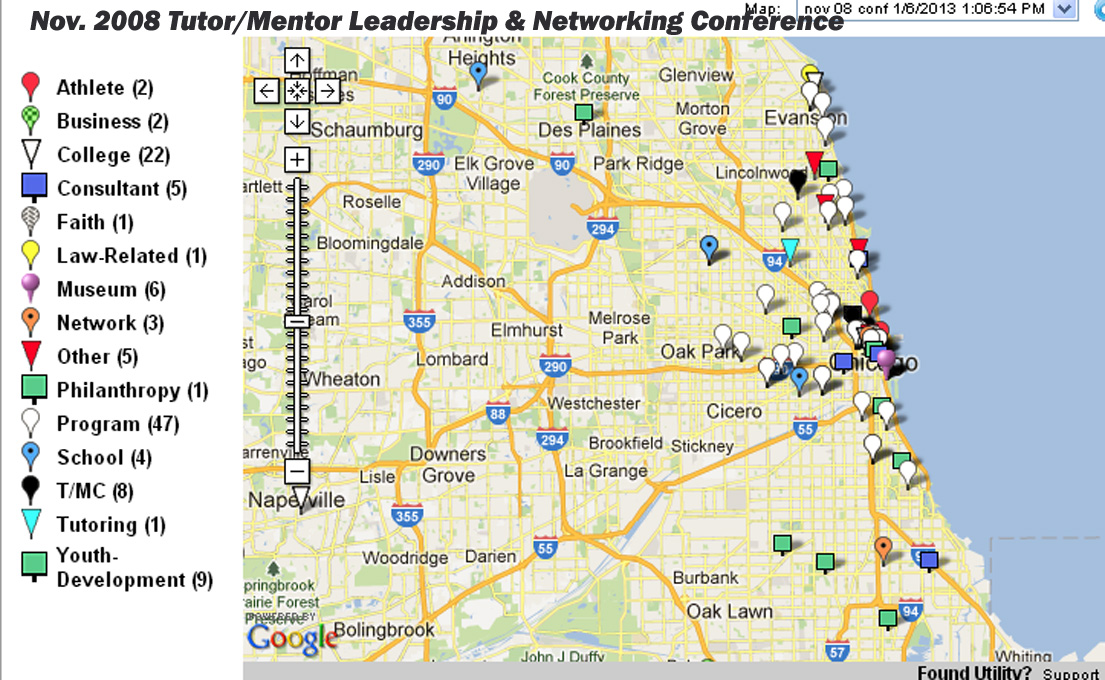
Nov. 1998 conference map
I hosted Tutor/Mentor Leadership and Networking Conferences in Chicago from May 1994 to May 2015 and created some maps to show participation.  I've also created concept maps, to show the range of talent and networks I was trying to attract to the conferences, and to help me help tutor/mentor programs grow throughout the region. 

You can see from viewing my maps that too few people from business, philanthropy, media, politics, universities and faith groups were attending the conferences I was hosting.  You can also see, from viewing the #clmooc participation maps from the past three years, that too few people from Chicago or other urban areas are participating in their efforts. 

You can change that by visiting the #clmooc site, joining the group, and adding your name to the map.

While participation ( or non-participation) in the Tutor/Mentor Conferences could be the topic of many discussions, my goal with this article is to encourage others to think about mapping participation in events they host (on-line and face-2-face) to show "who needs to be involved and interacting with each other" and "who is already involved"  

Duplicate the #clmooc.  Look at the image shown in this Tweet. Imagine many people from throughout the Chicago region, and the world, interacting and sharing ideas about who needs to be involved in on-going efforts intended to build and sustain needed youth and family service and jobs programs in every high poverty neighborhood of Chicago or other parts of the country, or the world.

Interested in helping? This could be an on-going project hosted by a college group, or even a high school service learning course.  Tweet me @tutormentorteam or post a comment to this article if you're interested in exploring this idea.

Friday, July 7, 2017

Interactive map showing home price data

WBEZ91.5 Chicago is doing some of the best research and mapping that I see in the Chicago region so I encourage you to visit their web site, Facebook page and other links and find ways to  use these tools in  your own communications.

Here's map/article that shows home prices in metro areas around the US.

Monday, July 3, 2017

Why I Created Tutor/Mentor Connection in 1993. Why I Still Lead it.

I started leading a volunteer-based tutor/mentor program in Chicago in 1975 while holding a full time retail advertising job at the Montgomery Ward corporate headquarters in Chicago.  I used many of my advertising skills to support a volunteer based that grew from 100 to 300 between 1975 and 1992, then to support fund raising in the years since then.

Over the years I saw many media stories talking about violence in Chicago, and editorials saying "we need to do something" but no strategies similar to how the corporate office supports hundreds of stores located all over the country.

In late 1992 while forming a new non profit to serve 7th-to-12th grade kids who were aging out of the original program, I and the six other volunteers who were helping me, decided to fill the leadership void that I'd seen over the previous 17 years. We created the Tutor/Mentor Connection, to help volunteer-based programs like the one I had led, and the new one I was forming, get the resources needed to grow in all high poverty neighborhoods of the Chicago region.  All of the ideas and information on my blogs and web sites, created since 1993, focus on that goal.

I signed up to take part in the summer 2017 Connected Learning #clmooc group activities, and added myself to their member map today. I first joined this group in 2013 and over the past four years I've developed some strong idea-sharing relationships with people from different parts of the country and the world as a result.

Village cMap
I’ve been trying for the past 20 years to build this type of learning community, connecting all of those who are concerned with the gap between rich and poor in America, the education system, workforce diversity, social justice, violence, public health, and a number of other reasons to be involved. Some people talk about the "village" it takes to raise kids. I write about it and try to bring members of the village together.

As I wrote above, I started leading a volunteer-based tutor/mentor program in 1975 (see history) while I held a full time job with the Montgomery Ward company. While our program grew to include over 300 pairs of youth and volunteers by 1990, funding was not an issue because all of the leaders were volunteers.

However, in 1990 when I converted this program to a 501-c-3 non profit and needed to raise money to pay salaries for myself and others to stay involved, the funding of non profits began to become a real issue. Over the years I’ve aggregated a wide range of personal frustration on the challenges small non profits face in finding consistent operating funds, and I’ve built a library of articles that show how others think on this topic.

I illustrate my thinking visually so let me show some maps that I think many of you will find interesting, and useful.

This is a map showing nearly 400 foundation (corporate and private) in the Chicago region and Eastern part of the United States who I put on my mailing list between 1993 and 2005.

Every year I send copies of my printed newsletters to these people, showing why tutor/mentor programs were needed and what I was doing as a direct service provider, and as leader of the intermediary Tutor/Mentor Connection.

The green icons on the map are foundations that funded my organization at least one time. Few funded me more than 2-3 years in a row. Some, like Montgomery Ward, funded me for seven consecutive years, then went out of business, and thus were not able to continue their support. None of the grants was larger than $50,000 and most were in the $1,000 to $10,000 per year range. Some were for general operating expenses, which I could use flexibly to build the organization, while many focused specifically on activities of the Cabrini Connections direct service program or the Tutor/Mentor Connection. In total I raised more than $6 million between 1993 and 2011, with a peak of $500,000 in 2000. This money split with 40% funding the Cabrini Connections direct service program, 40% the Tutor/Mentor Connection, and 20% funding operating and fundraising expenses. With no multi-year commitments, each year since about 1998 I started from zero in raising $300 to $400,000 from a wide range of donors.


This map shows a close up of the Chicago region so you can get a better sense of how many foundations I was reaching out to.

My organization never had more than 3 or 4 people on staff, and never had a full time professional development officer. I was CEO, chief innovator, chief marketing officer, newsletter writer, grant writer, janitor. Yet every year I was challenged to write letters of introduction, letters of inquiry, grant requests, grant reports, each with different requirements and different questions.

Yet we all were focused on helping expand the network of non-school hours support for inner city kids. By 1998 I was using web sites to show the work I was doing and what I was trying to do.

This map shows the Chicago LOOP area.

When I begin using maps I started following media stories about kids being killed in Chicago with maps showing where this was happening, and with links showing what tutor/mentor programs were operating in those areas, and what knowledge was available to community leaders, business and foundations, etc., so they would work to build programs that would provide more mentoring, tutoring and learning opportunities in more places.
In 2008 the T/MC created a Chicago Tutor/Mentor Program Locator with maps that show where tutor/mentor programs are needed, and other maps showing banks, hospitals, universities and faith groups who are spread in different parts of the city, and who could be supporting the growth of programs in each of these areas.

I keep asking myself, "Why haven’t leaders in these foundations use my maps, or similar directories, to adopt neighborhoods, then adopt tutor/mentor programs in those neighborhoods and make long-term commitments to help each program become the best in the world by borrowing ideas from each other and using a constant flow of operating/innovation dollars and volunteer talent to implement these ideas?"   No good answers to that question.

Here’s an interactive version of the map of foundations. You can enlarge the map and zoom in and see the name and location of each. Some no longer exist since this list was last updated in 2005. 

With more than 200 youth serving organizations in Chicago offering various forms of tutoring, mentoring and non-school support, we can have 200 development officers and/or Executive Directors reaching through this list to find foundations who will give them funds each year, which is a tremendous redundancy.

Or we can build strategies that educate and motivate donors and business partners to reach out and build proactive support systems for tutor/mentor programs in neighborhoods that need such programs.

I'm no longer hosting the May and November Tutor/Mentor Leadership and Networking Conferences, due to lack of funding. However, these could be started again, or we could build an on-line conversation, similar to the CLMOOC community, if partners and sponsors stepped forward to help.

This and other articles show why I created the Tutor/Mentor Connection in 1993. I still lead it, through the Tutor/Mentor Institute, LLC because no one else has created a similar 4-part strategy with the same aim at supporting the growth of mentor-rich non-school learning programs in all of the high poverty areas of Chicago.

We can do both. We can do better.