Showing posts with label politics. Show all posts

Sunday, November 2, 2025

Cook County (IL) Digital Equity Map

I'm always looking for websites showing uses of maps to focus attention and resources on many locations where people need extra help.  Below is the Cook County Digital Equity Map.


You can find the map here.  Click here to find information about how the IMPACT Small Grants Program is providing funding and storytelling support to local nonprofits, media organizations and libraries throughout Cook County.   

Join in the on-line Chicago Hack Night presentation this coming Tuesday (Nov 4, 2025) at 7pm and learn more about this program and an IMPACT Small Grants Program.  If you can't make the live presentation all Chicago Hack Night events are recorded so you can watch them later.

City Bureau is partnering with the Cook County Board on this IMPACT Small Grants Program. 

As you look at the Cook County map, look at this visual essay that I created in 2015 to show ways to use maps to focus attention and resources on EVERY high poverty area of Chicago and its suburbs. 


In this presentation I show maps of Cook County Commissioner districts, along with other political districts, like Chicago Aldermanic Wards and Illinois State Legislative districts.


Below I show maps of Cook County Commission Districts 2 and 3, and shootings that took place in their districts. 

I did not see a feature on the Digital Equity map that sorts the information by district.  How can Commissioners be held accountable if voters can't see where people need help, and where help is going?

I'd love to see maps on websites of every elected official that mirror the thinking I share in this visual essay.  It shows a collaboration across districts, focusing on shared geography, and shared commitment to helping people who need extra help.

Maybe this is being done somewhere. If you know of such sites, please share the link.  If not, share my presentation with elected officials and encourage them to build a platform with this functionality.

Thanks for reading.  

I've been sharing this message for over 30 years, but far too few people have seen it and thus, too few are applying the ideas. You can help, just by sharing my posts.

Connect with me on LinkedIn, Instagram, Facebook, BlueSky, Twitter and other platforms. Find links on this page.

If you value what I'm sharing, please chip in to help me pay the bills. Visit this page. 

Monday, March 1, 2021

Map resource for redistricting in 2021

 Every 10  years state political district maps are re drawn, based on the new Census information. Across the country Democratic and Republican party leaders try to "gerrymander" the maps to favor one party or another.

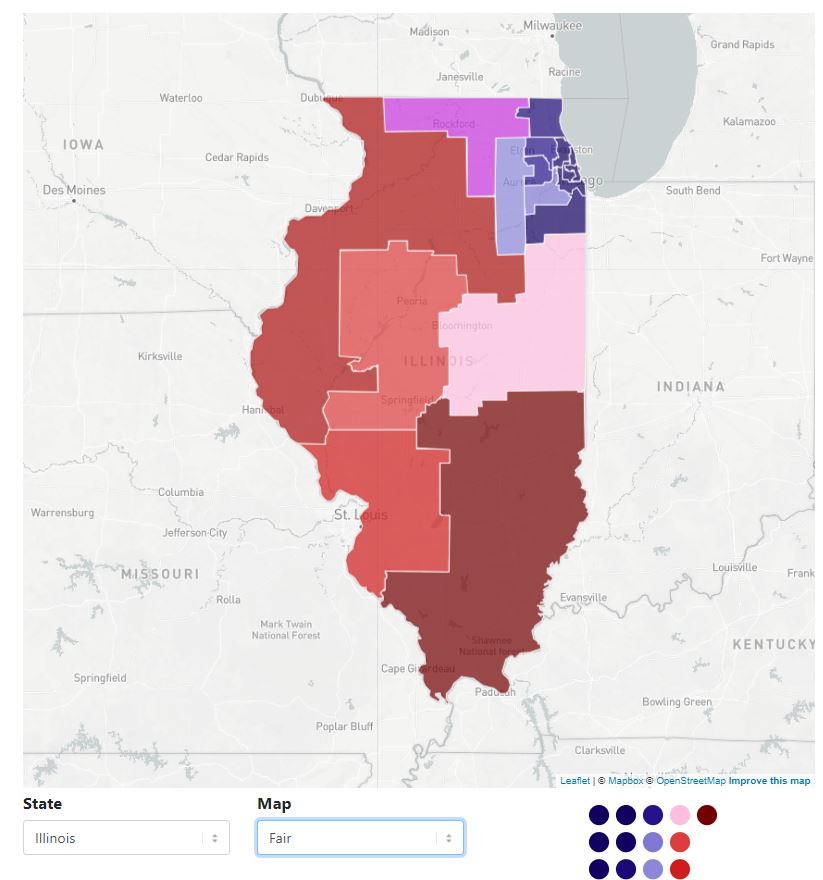
This platform provides maps for every state, showing maps favoring one party or the other, plus an recommended "fair map". 

Use the search bar under the map to find your state, then to see the three versions of the map. Which will your state choose? 

Tuesday, February 26, 2019

The Politics of Englewood

This is a  map of the greater Englewood area of Chicago, taken from a Southsideweekly.com article titled Without Representation: How Englewood got mapped into pieces.

I drew the line down the middle to show how the Englewood and West Englewood community areas are dividied.

I've posted a number of articles featuring Englewood, on the tutor/mentor blog.

Here's one from 2009, under  headline of:

Chicago Kids Victims of Neighborhood Violence


I encourage you to read the feature article of Sunday's Chicago Tribune, titled Innocence in Peril, which shows the tragic impact of violence and drugs on kids living in the Englewood neighborhood of Chicago.

 Then I encourage you to use the interactive tutor/mentor program locator to zoom in on the Englewood neighborhood (zip code 60621) and learn about existing volunteer-based tutoring /mentoring programs, or other youth organizations that provide some form of tutoring for kids in these areas.

This is map of Englewood from Tutor/Mentor Program Locator

 When you look at this, don't think of tutoring or mentoring as a simplistic strategy that cannot overcome the complex, deeply rooted poverty, segregation and racism in Chicago. Think of this as a strategy that connects adults, businesses, faith groups and other resources beyond poverty, in long-term personal connections which transform the volunteers and what they are willing to do to help kids and families.

 If we don't increase the number of people beyond poverty, who get involved with as much commitment as they would to help their own kids, we'll never have the dollars and political will-power to change the systems of support for kids living in poverty.

 As you use the interactive map, you can create overlays showing faith groups, businesses, universities in the area who could be helping tutor/mentor programs grow. You can also look at the highways that bring working people from the suburbs, through these neighborhoods every day. Look at the faith groups on the suburban end of these highways, and think of them as partners who could be educating their members to use this information, and their resources, to help tutor/mentor programs grow in poverty neighborhoods.

Visit the Tutor/Mentor Institute to learn more about strategies that readers of this Tribune story might learn so that they are more of the solution, than a drive by reader.
-----------------------------------------

In November 2015 I wrote another article, titled "Using Maps in Long Term Planning" and showed how an area where two shootings took place had multiple layers of political representation. 

The ChicagoSouthsideweekly.com article shows how this dilutes accountability, and may be contributing to the lack of progress on some of these issues.

I've been using maps to tell stories and draw resources to high poverty neighborhoods since 1994. Browse through sections of this blog, and the Tutor/Mentor blog, to see many of these.

If you value this work, I could use some help, with contributions, to keep on doing it. Click here if interested.

Friday, July 20, 2018

Elections coming - Vote for People Using Maps in their Leadership

Il 4th Congressional District
The Tutor/Mentor Connection started using maps in 1994 to help leaders understand where non-school, volunteer-based tutor, mentor and learning programs were most needed, and where existing programs were located.

This blog was created in 2008 to share maps that we were able to created between then and 2011.

 I've encouraged politicians to use maps since we launched this strategy.  Sadly, I've never seen this happen consistently.

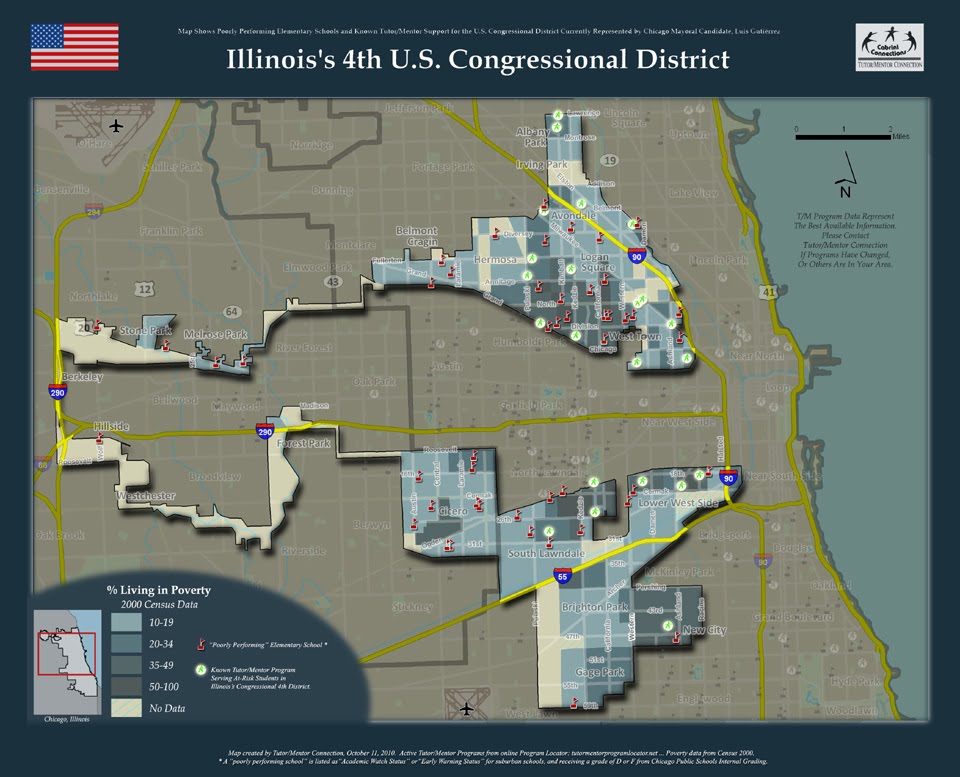
Yesterday I had another opportunity, when I had a brief discussion with a leading candidate for the Illinois 4th Congressional District election in November.  Above is a map of the district. Below is one of many presentations I've created showing uses of maps:


See more articles and ideas for using maps on this page of Tutor/Mentor Institute, LLC web site. 

Browse past articles on this blog and the Tutor/Mentor blog to see ways maps can be embedded into stories.

Help me keep the Tutor/Mentor Institute, LLC resources and stories like this on line. Make contribution using PayPal form on this page. 

Interested in helping me rebuild and update this resource? Introduce yourself with comment or connect with me on Twitter @tutormentorteam or on Linkedin.

Thursday, April 19, 2018

Does Your Elected Representative Have a Map Gallery on Her Web Site?

Yesterday I received an email newsletter from Spotlight on Poverty that featured an interview with Dwight Evans of the 2nd Pennsylvania Congressional District. It mentioned that he hosts maps on his web site and I did some digging and interaction with Rep. Evans on Twitter, to find the link.

Below is a screen shot of his map gallery page, with a screen shot of the ESRI map that you get when you click on one of the map icons in his gallery.  (2-3-2020 Note: the link to the Map Gallery now is here)

If you spend some time on this blog you can read articles posted since 2008 encouraging Chicago and Illinois politicians to  use maps strategically to show where non-school, volunteer-based tutor/mentor programs are needed in their district, who is already there providing these services (and who often need help themselves), and places where the incumbent has delivered needed support. That could be dollars, volunteers, attention, partners, or all of these.

My past articles and the maps the Tutor/Mentor Connection created are intended to inspire and serve as templates for work others could be doing in many other places.  Click here, here, and here to see a collection of articles.

While I focus on helping youth tutor/mentor programs grow, the map platforms and articles that I point to show many indicators of need and could be used to help a wide range of service providers....a comprehensive system of support....be available in different map areas.

My father's family is from Philadelphia and I've many siblings, nieces and nephews living there, so I hope Rep. Evans and others will take a look at what I've suggested, and that they will send me links to pages on their web sites where they host map galleries and blog articles showing their use of maps.

At the same time, this use of maps should be happening in Chicago, Illinois, every US state and in every big city in the world.

However, I can't influence what happens in most of these places because I don't live there. However, there's a strategy that you can follow.

Last Tuesday the weekly ChiHackNight featured Judy Hertz, Executive Director of Midwest Academy She gave an introduction a power analysis, planning and community organizing strategy that I think many could benefit from using.

Browse the #ChiHackNight tweets from Tuesday, April 17, and you can see photos and comments from here presentation. Here's the video from Tuesday's session.


If you do the research and follow her recommendations, you can help people in every district figure out ways to influence people in power. It's a process. It takes work. The maps can help.

If your elected representative is using maps the way I'm suggesting and hosts a map gallery on his/her web site, send me your examples and I'll add them as updates to this article.

2/25/2019 update - Crime in the 25th Ward - this analysis was produced buy Troy Hernandez, a candidate for Alderman in the 25th Ward of Chicago.  Not every politician is a data scientist, but each should have someone working with them who can provide this type of analysis to inform the voters in their district and to guide public policy decisions.


Monday, October 17, 2016

Divided Nation - Rural vs Urban America

On Saturday, Ann Medlock, of the Giraffe Heroes Project, shared a story on Facebook that prompted me to write this.  The article is titled "How Half Of America Lost Its F**king Mind" and was talking about how so many American's are supporting Donald Trump for President.

I read the article and encourage you to read it too.  If you live in a city, some of the ideas may turn you off, or challenge your thinking. If you live in rural America, or grew up there, you might say, as the author did, "That could be me."

Included in the article was a map showing the 2012 Presidential Election voting, on a county-by county basis.

The red counties on this map represent rural, mostly White, America. The blue counties represent urban America, with much larger populations of people of color. Reading the article I began to look at "TWO Americas" from a "rural-urban" perspective, not just from a "White-Minority" or "Rich-Poor" perspective.

Of course, they are all related.

What's driving the motivation of rural America is a changing economy that has caused factories and jobs to leave smaller cities and rural areas, leaving poverty and a lack of hope in its wake. The article talks about how popular culture (movies, TV, radio, music), coming out of urban Ameria, have helped prepare rural America to accept Trump. One line in the article was, "He's our "asxhxxle"

I did a little more digging today, and visited the web site of Mark Newman  There are several more maps on the site, like the one below. This shows that not all of the Red counties are 100% Republican and not all of the Blue counties are 100% Democratic.


What this map does not show is the racial mix across America.  The article about rural America voting for Trump does not focus on the race and inequality issues that Black American's have been focusing on, yet it's there.

I recalled another web site that I saw a couple of years ago, with what's called a "Racial Dot Map". I've included a screen shot below, showing the full country.  The map has color coded dots showing where different racial groups are most concentrated.
You will need to open the site and zoom in to get better information from this map, but just by comparing this to the map above, you see two patterns. A large part of the Republican counties East of the Mississippi are high majority White. Cities and urban areas across the country have high minority populations.  However, the areas West of the Mississippi, mostly Republican, have very low population density. This is lack of population density is a different rural America than Appalachia and the US South.   I encourage you to read Newman's article and see how he describes how population density affects the general election vote, as well as the Electoral College vote.

My take-away?

First, the issues of race and poverty in America are complex, and getting consistent attention of people in Red and Blue states will be difficult.  For the past 40 years I have focused on helping urban areas build and sustain non-school support systems for youth living in poverty.  However, I've recognized that there needs to be a parallel group duplicating my efforts, with a focus on rural areas. I recently found an organization called Rural Assembly, who is doing some of this.

Second, the problems facing rural American and its loss of jobs, rising poverty, growing drug abuse and suicide rates is also a wicked problem, that won't be solved by more tutor/mentor programs. It's not a problem I've spent much time thinking about, since the problems I do focus on are far beyond my own area of influence.

However, graphics like this illustrate a path toward possible solutions. It shows how a few of us can reach out to others, and build a network of learners, which grows over time. 


In articles on the Tutor/Mentor blog I focus on learning, complex problems, network building, etc. These do apply to both of the issues this article focuses on.  Getting more people personally engaged in learning about the problems we face, and using their own time, talent and dollars to build solutions, is the one strategy that I keep sharing that can lead to a more connected America focusing on problems, not personalities, and focusing on well-thought-out solutions, not vague promises. 

I hope you'll take a look.


Jan 27, 2017 update.  The election is over and Trump won. People on the left are in panic mode fearing the destruction of our democracy by a Hitler-like Trump. Poor people who voted for Trump are likely to suffer as much, or more, from program cuts he is proposing. So why did they vote for him?  This MotherJones article offers a look into that voter and his motivations.   For people on the left to create an alternative to Trump, they need to understand and find ways to connect with people who voted for Trump.

Jan 31, 2017  update - this Gallup.com site show the most conservative and most liberal states in the US, emphasizing how difficult it will be to build a middle ground consensus in America.

Feb 18, 2017 update - This link points to a set of articles, starting with "America's long (unaddressed) history of class.  http://www.wnyc.org/story/americas-long-unaddressed-history-class/

June 19, 2017 update - blogger writes about hopelessness in rural America. click here

Aug. 11, 2017  update - Rural Poverty in Illinois growing faster than urban poverty. - article

Jan. 2, 2018 update - The 100 year capitalist experiment that keeps Appalachia poor, sick and stuck on coal. - article 

Jan 8, 2018 update - The Divide Between America's Prosperous Cities and and Struggling Small Towns - in 20 charts - WSJ article

Jan. 8, 2018  update - Native Americans and Path to Voting Rights - NY Times article

July 20, 2018 update - review of community organizing around racial justice issues in rural America - pdf - click here

April 13, 2020 update
- two useful resources are The Center on Rural Innovation and The Rural Opportunity Map

December 1, 2020 update
- why Democrats keep losing Rural American voters - with recommended fixes. click here

 Jan 26, 2021 update - Five Ways Joe Biden Can Help Rural America - click here

Nov 22, 2021  update - St. Louis Federal Reserve Bank released collection of essays focused on "Investing in Rural Prosperity". Find full collection at this link.   

Then read the essay titled "Geographic Equity belongs in Federal Policy Making" - click here 

On page 4 of the introduction is this statement "If you are working to alleviate poverty or generate prosperity, map the location of program beneficiaries & layer it w a #map of persistent poverty counties. If program benefits do not reach the poorest places, you may be inadvertently contributing to our inequitable system."    This describes a use of geographic mapping that I've proposed for over 25 years. 

December 27, 2022 update - "Redefining Rural: Towards a Better Understanding of Geography, Demography, and Economy in America's Rural Places".  March 2021 article.  click here

March 4, 2026 update - "No 'Silver Bullet' For Economic Resurgence in Hard-Hit Rural Areas".  From Spotlight on Poverty and Opportunity - click here

Saturday, June 16, 2012

Maps of Cook County Government boundaries 2012

Visit this link to find maps showing the current Cook County Government boundaries and the proposed new boundaries.


With more and more people learning to use maps our hope is that they will use them to mobilize volunteer talent and dollars to support the growth of mentor-rich youth programs in areas with highest concentrations of poverty, violence and poorly performing schools.

Elected officials can provide the leadership to bring people together and focus attention on this issue and they can be held accountable by voters for what they do or do not do.

Businesses, hospitals, faith groups in a geographic area can also provide leadership and be held accountable.

Visit more of the articles on this blog to see how maps can be used. This project is in a dormant stage now since funding is no longer available to create these maps and write these stories. However the examples illustrate what is possible.

Friday, March 2, 2012

Use maps to change the political will!

I encourage you to take a look at the Kids Count Data Center, which is provided as a service of the Anne E. Casey Foundation. You can make your own maps using the data on the site, or if you are a GIS expert, you can download the data and use your own GIS. I don't have a lot of time to dig through this DataCenter to know what types of maps can be produced, but I hope it has the capacity to go beyond state level to view the data at the city or county level. There is such a difference between poverty in big cities like Chicago and the rest of the state of Illinois that a statewide report does not really show how bad things are in the big cities.

Furthermore, I would like to see an example of how the maps can be used to build public involvement in actions that reduce poverty based on information shared by many organizations via the Internet.

I posted this article to show how maps could be used to mobilize enough votes to pass legislation regarding high school drop out issues.

I posted this article to show how people can make their own map stories using the Tutor/Mentor Program Locator.

And, I posted this article to show how people can communicate these ideas to their own networks and take responsibility for "expanding the choir" of people involved, and who ultimately vote for public policies favorable to helping the poor and the organizations helping the poor.

I'd be happy to spend a couple hours with your organization or company to help you understand and apply these ideas. I'd love to help your school create a Tutor/Mentor Institute Club, where students learn to apply these ideas so they can have a greater impact on what adults to to support their own learning opportunities.

Friday, February 18, 2011

Where Each Chicago Mayor Candidate Stands on Education and Mentoring

"Government can’t do everything you want it to do. ... That’s why you have partnerships with non-for-profits and profit organizations." – Mayor Richard M. Daley, 2/9/2011

Chicago’s voters will choose a new mayor for the first time in over 20 years this coming week. I found surveys online that puts each candidate’s ideas about education in their own words.

If you live here, you probably don't need my maps to tell you that Chicago is dealing with a crisis of poor school/student performance. In fact, I can't personally remember the last time I saw a news story that framed Chicago's public schools in a light that didn't include failing, closing, mismanagement or crime.

Against this backdrop, I have written a lot of articles for Mapping For Justice that supplement the ongoing negative news with stories of hope, showing cases where tutor/mentor programs are helping some of these communities, and advocating for leadership to build tutor/mentor support in areas where our kids need as much help as possible.

I have also come to believe, based on my research, that poorly-prepared students become poorly-prepared adults and eventually becomes a taxpayer burden for everyone. For this reason, I feel this is an issue voters should not ignore when choosing Chicago's next leader.

Recently, Cabrini Connections program leader Dan Bassill wrote, "I wish voters in Chicago were holding the Mayor and other elected officials accountable for what they do to improve student learning ... voters and leaders need to do their own homework to know more about the poverty gap, and why it is a critical issue that affects all of us, not just the poor."

So with that said, my intention today is NOT to endorse a particular candidate. Instead it is to share the links to the education surveys I just read, so you too can take a look at each candidate's proposed plan - in their own words. So we can do our homework.

I've listed the candidates in alphabetical order, and highlighted moments in the surveys that I feel might relate on some level to tutoring/mentoring (the theme to my maps). Oh and of course, I've added a few maps. Click on these to see how maps make elected leaders more effective!

Carol Moselely Braun

* Read her full survey here.
* Read a recent MFJ article that features Braun here.

Braun reminds us of her support as Senator for "Midnight Basketball programs, which brought local youth together with local police officers." This is as close as she gets to discussing tutoring/mentoring programs.

Much of her plan focuses on what she believes needs to happen in the schools. For instance, she calls for an expanded curriculum that includes courses students find attractive, to can keep them from dropping out. She also wants to add vocational training to the curriculum, to "provide students with the skills to be more competitive in the workforce and less likely to join gangs."

It makes sense that the majority of a candidate's policy would be focused on the schools. After all that's where the students get the bulk of their academic and social training. However, I wonder if these candidates have looked into using non-school mentoring programs that could give a boost to their efforts to keep students in school, on a path toward the workforce, and away from gangs.

Braun does suggest that her administration "will coordinate social services to meet such needs that transcend teachers' ability to resolve, such as homelessness, hunger, poverty and traumatic home environments," so maybe the connection will eventually happen.

=========

Gery Chico

* Read his full survey here.
* Read a recent MFJ article that features Chico here.

Chico regrets that the afterschool programs he accomplished as President of the Board of Education "have been scaled back and in some cases, eliminated." These programs "gave nearly 200,000 CPS students alternative and constructive things to do."

Indeed, the city budget is a mess, so I hope when he suggests that "by partnering with community organizations ... we can leverage resources to reduce costs," he's aware that there is an existing network of tutor/mentor programs Tutor/Mentor Connection (T/MC) has in their directory that are also currently giving CPS students "constructive things to do."

=========

Miguel Del Valle

* Read his full survey here.

A former CPS student, with a community organizing background, Del Valle says, "I am inspired by efforts where neighbors, churches, and other partners work together to ensure the safety of our children. I will encourage and support all such programs in conjunction with parents and neighbors [and] non-profit organizations..."

Del Valle has strong ideas about how to "provide youth with [at-school] opportunities to engage in positive activities and contribute to community life through after school programming." In fact, he seems to provide the most detail in his survey, regarding specific education policy goals, proposed programs, and developed ideas about where the money will come from (taxes, TIF funds, and private sector alliances included).

He also seems, looking at the surveys, to have the best-developed plans for what to do with kids in non-school situations, proposing "an expanded program called 'Community Learning Centers' to create extended day learning opportunities that may include technology clubs, the arts, sports, tutoring, and specialized programs for students. This would be done by creating partnerships among the private sector, nonprofit organizations, and schools."

Del Valle echoes the hopes of the tutor/mentor community when he states that, "it is imperative to promote and help bring to scale programs that intervene and bring corrective action to get youth back on a productive path rather than simply emphasizing punitive measures that lead down a path to nowhere."

=========

Rahm Emanuel

* Read his full survey here.

Much of Emanuel's platform seems to focus on programs that will happen at the school. He "calls for comprehensive after-school programs ... integrating child intervention programs across departments." He calls this win-win for the students, citing after-school programs' abilities to "both increase academic progress and reduce violence. He seeks funding through "school partnerships with local businesses and non-profit organizations that want to target specific schools."

Perhaps he too is aware of the existing network of non-profit tutor/mentor programs available to partner with the city and support student development when the students are away from school. T/MC can even map which resources are available near the "specific schools" he wants to target.

After all, Emanuel does want to "incent community based organizations, citywide non-profits, universities, commercial companies and other civic institutions to bring their people and programs to bear to support particular struggling schools by providing mentors, tutors, job training, access to college courses, and in classroom support to schools that need it most."

=========

William Doc Walls

* Read his full survey here.

On a personal note (as map geek), I'm fascinated by Walls' interest in "increasing the use of Crime mapping and data analysis" to help combat crime in high poverty neighborhoods.

But staying on topic, and looking for indications that Walls intends to incorporate tutoring/mentoring into his plans to support for at-risk students, Walls does say that he "will provide tutoring, social skill development and increased recreational activities in an effort to achieve normal educational accomplishments in chronically low-performing schools."

He does not go into great detail about how this will happen, yet I am hopeful he supports existing programs in his community - he does offer some genuine opinions and somewhat creative/alternative solutions to problems his community faces.

=========

Virginia Van Pelt Watkins

* Read her full survey here

An alumnus of Fenger High School with an intimate understanding of the challenges and hazards at-risk students like Fenger's Derrion Albert face, Watkins outlines her ideas for school leadership, curriculum, quality schools, and teacher mentoring.

Particular to student tutoring/mentoring, she wants to "champion for early child education" and promises to "remove barriers families experience in accessing existing early childhood education programs and services."

She also touches briefly on "peer-to-peer mentoring programs that are developed with and supported by youth" but does not mention partnerships with existing adult-student tutor/mentor programs specifically.

Remember! Polls open at 6am this Tuesday, February 22!

Find your polling place and other information about the election here.

And let's make sure whoever wins keeps their promises, and explores all resources available to improve the health of our schools and the prospects for our students.

Friday, January 21, 2011

Tom Tresser Calls NPO Leadership to Action in Chicago's Mayoral Election

I think it’s time Chicago’s mentor program leadership got together and demanded some real investment by political leadership. With the coming mayoral elections on the horizon, the time is now. Bear with me as I explain.

When I signed on three years ago as GIS Specialist for non-profit Tutor/Mentor Connection (T/MC), I was finishing my M.Ed and working in a Chicago Public School (CPS) on Chicago’s high-poverty, crime-riddled west side. I believe that the majority of CPS students I have met these past years are talented with academic upside (and if you don’t agree, I have to doubt you have actually met any of them).

Unfortunately CPS students are often underprepared at an early age, in comparison to students I have worked with in “better” suburban schools. Many of them read at a lower grade level. Many do not have optimal parental support. The schools they attend are often poorly equipped in general.

While this inequity itself is well-documented, it seems sometimes, no matter how much empirical research I cite, I struggle to guide the discussion away from finger pointing and toward an understanding that poverty (and the poorly-equipped students that are often raised in poverty) are everybody’s problem, no matter how far away from Chicago you move, or who is at fault.

Why?

Across bipartisan lines, most would agree I think that underprepared students grow up to become adults that are underprepared to be workers, parents, and citizens. In worst-case scenarios, the costs of crime, prisons, and welfare affect taxpayers everywhere. So for me the question is, do we want to look for solutions to help at-risk students take care of themselves now, or do we prefer to have to take care of them later, with a continued cost of poverty?

Here’s the good news, as I’ve come to learn: Contrary to what the media too often shows (and far too many people I talk to in casual conversation believe), many CPS students are actually... smart. As a teacher whose job was to provoke critical thought among inner-city social studies high school students who were often reading at an elementary level, I constantly marveled at how many of these students had creative, outside-the-box approaches to complex historical and civics-related problems. They often have the ideas but not the tools, if you will.

Many of these same students are also willing to take on additional tutoring and commit to long-term mentors, when such opportunities present new tools, and new hope of a brighter future. Indeed, as a teacher then, and as a volunteer now, I continue to meet students with the initiative to enroll in optional school-based tutor programs like AVID, as well as non-school tutor/mentor programs like Cabrini Connections.

That’s half the battle, right? Finding large numbers of at-risk students who are willing to take the extra step to receive supplemental academic and decision-making support, bridge the gaps they face in their development, and put themselves on paths to college and career, versus continued poverty?

They’re out there, and I know for fact that mentoring programs can work. My personal stories aside, I recently wrote a blog that featured the story of Urban Prep Charter Academy for Young Men, a high school in the notorious Englewood neighborhood that employs full-time mentors, and in four years has put more than 2/3 of their incoming freshmen into four-year colleges, despite the fact most arrived reading at a sixth-grade level or below.

But back to the point. Three years ago, I signed on at T/MC, a program that has been trying to organize resources that support mentoring programs and encourage new "Urban Prep"-like case studies in neighborhoods everywhere.

All I was being asked to do was use my skill as mapmaker and GIS professional to show how T/MC program data could be visualized – in map form – to the advantage of political, business, or other community leaders whose goals included safer communities, better schools, workforce development, and tax relief.

I jumped at the chance to work with an organization that was trying to take the lead, organizing bi-annual conferences designed to bring mentor program leadership together, and stockpiling data and information in a centralized hub for these same leaders to use and share.

To me, it all made so much sense. Help build it, I thought… and as sensible people, they would come.

Well, three years later, politicians are still talking about crime and schools and workforce malaise.

People are more freaked out than ever about crime and schools and workforce malaise.

Reports continue to show that mentoring helps address crime and schools and workforce malaise.

And yet somehow, there’s still little unity among the city’s mentor programs, and it’s still not fashionable for political leaders to include mentoring as a part of a proposed solution to the items on their agenda.

For me, I continue to work in obscurity. And while I’m told by some to remain patient, I can’t help but lament that my efforts have been overlooked... with no indication this will change. After all, attendance figures at mentoring conferences I attend aren’t really soaring, we have seen a virtual freeze in donations and other investment in our technologies, and my web analytics tell me that very few people will probably even read this, honestly.

But maybe that's just the nature of the blogosphere beast. Maybe I'm not really alone in any of this, and am instead just a single fractured voice, lost at sea trying to find others with similar concerns and ideas – others who are out there but are also failing to find a unifying force.

Last week on Outside The Loop Radio, WLUW Chicago, host Mike Stephen interviewed Tom Tresser, an instructor at DePaul University and IIT, a former candidate for Cook County Board President, and a non-profit veteran since 1980.

Tresser recently issued a rallying cry of sorts in the Beachwood Reporter, which he then echoed during his interview on the Outside The Loop program. He too sees a lack of unity among non-profit leadership across the board, and is urging Chicago’s non profit leaders to “take advantage of a once in a lifetime opportunity [to] get involved in the 2011 election for Chicago's mayor.”

I felt a shiver of hope (misery loves company, I guess) when he pointed out that, while all non-profit sectors are suffering with familiar disunity and dwindling funding, NPOs do employ hundreds of thousands of workers in Chicago. In other words, they remain a vital source of employment and a potentially powerful constituency for a politician looking for votes.

Unfortunately, we don’t have the unity, clout, or power at this point to take advantage of our numbers in the political arena, he says.

Tresser explains, "Elected officials have a reptilian brain.” They size up an interest group and determine “can this entity help me or hurt me” and if it can do neither, it ignores them and moves on. He says, “You've got to show how you can help or hurt a candidate in order to be taken seriously.”

We’ve seen how mentoring can help politicians. My recent blogs have cited issues our mayoral candidates are employing in their campaigns, and how mentoring can help them achieve their specific goals.

So my question to the leadership at T/MC and mentoring programs everywhere is: Who is going to step up in the name of mentoring, and forge the politically powerful “vast constituency” Tresser insists is necessary to secure the ears and support of those in power; politicians who have the influence to make mentorship a fashionable component of any political platform, while encouraging volunteering, new leadership, and new investment in mentoring everywhere?

This is the reason I got involved with T/MC in the first place – its mission is one of community and unity among program leaders everywhere, as evidenced by T/MC's commitment to their bi-annual conferences, and their mission “to help [programs] already operating, then help new programs form by borrowing from ideas of existing programs.” There’s is a clear commitment, from the top at T/MC, to the unification of mentoring leadership throughout the Chicago area.

So who is going to step up?

And by the way – for those leaders who are hoping Tresser backs up his call to action with an explanation of how this can work (after all, non-profits are forbidden by law to engage in politics directly), Tresser does lay out a strategy for working around this little hurdle, if anyone cares to read or listen about it.

And I hope he is onto something tangible, because it stands to reason that if non-profit leaders fail to organize and obtain real influence, they will continue to be ignored and eventually disappear. Tresser points out that even in a solid economy, 60% of non-profits struggle to make ends meet, but that in this crippled economy, the state of Illinois now owes 1.4 billion to non profits, while the government continues to bail out the "banks, insurance companies, General Motors and Goldman Sachs to the tune of trillions of dollars.”

I signed on three years ago to make maps on a part time basis. I am a foot soldier in this war on poverty. Three years (of watching T/MC struggle) later, I impatiently wonder if an alliance of non-profit leadership can happen in time to influence this mayoral election.

Or if it will ever happen.

Wednesday, January 19, 2011

Map Gallery: Congressman Gutierrez Endorses Gery Chico for Chicago Mayor

Gery Chico - Running For Mayor

“Each community provides unique opportunities for partnerships that can enhance our children’s education..” - Gery Chico

(Part 12 of T/MC's "Mapping Solutions" online gallery)

This past week, influential Chicago politician Luis Gutierrez, a US Representative whose district is featured on this first map (click to enlarge) came forward and endorsed Gery Chico in the race for Chicago’s next mayor.

Lately, I’ve been publishing an series of maps that we at Tutor/Mentor Connection (T/MC) made, featuring political boundaries in Chicago.

Of course, we at T/MC do not endorse specific candidates. We simply wish to showcase how T/MC can customize a map to analyze the distribution of tutor/mentor services in any given region (in this case, a political district), and how we can also provide a birds-eye view of neighboring community assets for local leaders (in this case, for the next mayor of Chicago).

We will also suggest, looking at each candidate’s personal platform and concerns (so far we have also looked at Carol Moseley Braun), that each candidate should have an interest in either supporting mentoring through direct action, or at the very least should be using their influence to tell their constituents how mentoring can supplement their efforts to address the issues they promise to tackle. This leadership might then steer other community leaders, volunteers, donors, and parents to these vital non-profit services in an economy where such services are at more risk than ever of disappearing.

It's not hard to find examples of how mentoring supplements the work an elected leader needs to do. For instance, Gery Chico tells us that, “residents with jobs means safer and more prosperous neighborhoods, tax dollars saved from less social services and additional city revenue as more people spend money, buy homes and earn income. The impact of each new job ripples outward through the economy, creating secondary and additional benefits.” To this end, Chico desires to “work with business partners to build technical and career programs that prepare students with the technical and occupational skills they need to find good employment.”

We have a database of over 200 tutor/mentor facilities that are already in place, working toward this same goal, and I have written on this blog about how mentoring can bolster our workforce by helping students choose books and careers over less desirable paths.

On education, Chico states that, “without an effective school system we cannot prepare kids to compete in the global economy, or provide the labor force that will attract good companies to locate in our great city.” His “Ready by Five” initiative seeks to ensure that “every child is prepared to learn and succeed by the time he or she reaches kindergarten.” He also wants to “create a Parent Academy for every school” that will help parents who “lack the resources and knowledge to effectively help their children succeed” learn those skils.

These are great ideas that can be supplemented by mentor-student relationships that help kids who are "ready by five" stay the course toward globally competitive careers, while helping these same young adults achieve the academic and vocational success that will support their ability as the next generation of parents to effectively help their children succeed as well.

On the issue of crime and safety, Chico lists several ways he might make schools themselves safer, but I suspect he might also be interested in learning how a mentoring program in a high-crime neighborhood like Englewood could help its young men stay out of trouble, graduate, and enroll in four-year colleges at an unprecedented rate. He might then explore how similar mentoring programs might improve the well-being of students (and adults) in every neighborhood.

Chico is an advocate of community-level “partnerships that can enhance our children’s education” and promises to "partner with foundations, community groups, museums, government institutions, etc. to bring innovative and diverse programs and learning opportunities to our schools."

Perhaps he and the other candidates - whether they become mayor or not - are already exploring how partnerships with established mentoring programs can supplement their efforts to achieve their vision of a prosperous, safe, and educated Chicago.

Friday, January 7, 2011

Map Gallery: Danny Davis drops out of Chicago mayor’s race, endorses Braun

Carol Moseley Braun - Running For Mayor

“We can’t have a city divided or a people divided...We must make sure Chicago’s future is brighter.” - Carol Moseley Braun

(Part 11 of T/MC's "Mapping Solutions" online gallery)

U.S. Congressman Danny Davis and Reverend Senator James Meeks have pulled out of Chicago’s mayor’s race, and are now endorsing Carol Moseley Braun, in the upcoming battle for Chicago’s top boss. Their collective battle cry revolves around “unity.” I can only hope "unity" is a policy-related concept, as much as it may be useful in consolidating votes.

At our map gallery in November, we featured maps that provide birds-eye views of Congressman Davis’s district, as well as Senator Meeks’s district, in an attempt to show how Tutor/Mentor Connection (T/MC) maps could help Chicago’s next mayor -whomever it may be - become better equipped to address voter concerns such as education, crime, and economic challenges.

(These gallery maps are only samples by the way, and similar maps showing relationships among community resources - or lack thereof - could be easily be customized to the specific needs of any elected official or community leader. )

Carol Moseley Braun, as Chicago’s next mayor, would obviously face the same challenges as Davis and Meeks. Using a map similar to the Davis map above (click to enlarge), she too might visualize where businesses and other community resources such as hospitals and colleges are operating, in relation to poverty and existing support systems for at-risk youth (such as tutor/mentor facilities). She could then allocate resources, or facilitate unity among community leaders, as she sees necessary.

She might also notice where highways cut through the city, in relation to poverty and poorly-performing schools, and perhaps encourage commuters interested in "service" to become active in student-focused programs, thereby uniting volunteers from relative wealth and success with intercity youth who might not otherwise have mentors in their lives that can provide strong career paths.

Like Meeks, Braun might use maps to visualize and unite our faith community, in areas where students live, and then build tutor/mentor facilities to help local youth onto paths that lead to college and career, versus welfare and crime.

Maps can show relationships among school performance, crime, and all of the aforementioned resources as well. Braun’s platform and political track record show that education and public safety are serious concerns of hers, recognizing that “kids should be able to expect a quality education in their own neighborhood... [which] will take involvement from parents, teachers, our community and our government,” that the “best way to stimulate economic and educational development is to keep people safe," and that "it will take a mayor with diplomatic, coalition building expertise to bring together the resources Chicago needs to protect its neighborhoods.”

As a long-time resident of Hyde Park, an island of academic and business wealth in an area of the south side of Chicago that is relatively impoverished and crime-ridden, she has first-hand concerns that the recently reported drop in violence might be misleading, and reminds us that crime is still a serious problem, before offering a message of hope, that violent crime “is not insurmountable. This is something we can do something about."

She cites mentoring programs as part of the solution.

Perhaps she is using maps to help her visualize where these mentoring programs might be needed most. And then uniting resources the maps show are available to help build great programs all over the city.

(I should mention that these maps are not intended to show where service work is, or is not occurring. They are also not meant to endorse, or criticize elected leaders. The voters should make those decisions.)

Monday, December 13, 2010

Running For Mayor: State Senator James Meeks

Helping Local Politicians Support Tutor/Mentor Programs

"Our goal is to make sure every third-grader is reading at a third-grade level." - State Sen. James Meeks

(Part 5 of T/MC's 2010 "Mapping Solutions" online gallery)

Maps can be used by elected leaders to help quality youth programs grow in all parts of their districts. My last blog showed an overview of Chicago's wards and incumbant aldermen. More on city council later.

Today, I would like to zoom in on a particular district, Illinois Senate 15th, currently represented by Reverend James Meeks, who just happens to be running for Chicago Mayor in the coming election.

When Tutor/Mentor Connection (T/MC) makes maps that zoom into a neighborhood or district, we can reveal points of interest - community assets - that can be used to support or build tutor/mentor programs, in an effort to ensure that the third graders to whom senator Meeks refers in the quote above, do in fact receive the scholastic and decision-making foundation needed to remain interested and successful in school and beyond.

Today, I am featuring a map (click to enlarge) from our recent map gallery that shows a thematic overlap between our politicial strategies, and our faith-based strategies featured in Part 2 of this "map gallery" series.

As always, in today's map I show areas of high poverty and schools that are not meeting state and CPS standards, in relation to known tutor/mentor programs. Remember, the capacity of each of these programs on the map is far less than the enrollment of each of the overwhelmed and underachieving schools shown. With this in mind, ask yourself whether we need to build more programs to supplement the efforts of schools and parents, to make sure at-risk students stay on track for long-term academic and vocational success. Then ask yourself where these might be needed.

This particular map reveals a selection of Christian faith-based assets that might take the lead in making this growth happen. Since we are featuring Mayoral candidate Meeks, the map features Salem Baptist Church of Chicago, which Reverend Meeks founded, where he worked as pastor, and where he remains a spiritual leader - not only for Salem Baptist's 24,000 followers, but also for the dozens of other Baptist congregations in his political district, represented here by dark blue crosses.

Tutor/Mentor Exchange has a document called How Faith Communities Can Lead Volunteer Mobilization For Tutor/Mentor Programs, detailing how a spiritual leader like Meeks "can be delivering sermons on a regular basis, that tie scripture and service, and point members to tutor/mentor programs that already exist, or to neighborhoods, where new programs need to be created."

Perhaps Senator Meeks can use his influence (spiritual and political) to lead other denominations in his district as well. Non-Baptist Christians on this map are represented by light red crosses. Each of these locations represent additional sites where congregations can meet to learn about tutoring and mentoring, and where church leaders can evangelize to get donors to contribute to the growth of programs.

Reverend and Senator (and perhaps Mayor) Meeks is no stranger to the wisdom of mentoring. While he is probably more famous for speaking out on the problems created by inequalities in the education of our students, he has also taken action, having initiated a mentoring program called “It Takes a Village,” to provide support and assistance to pregnant youth and young mothers. We still do not have this program in our Program Locator, and would love to work with Senator Meeks to build new programs for the students in his district where our maps suggest a need.

(I should mention that these maps are not intended to show where service work is, or is not occurring. They are also not meant to endorse, or criticize elected leaders. The voters should make those decisions.)

If you feel T/MC technologies are important...

===============================

We at Tutor/Mentor Connection (T/MC) have spent the past several years using maps to identify and analyze areas of our city where support for at-risk youth needs to grow, in order to make our students brighter, our workforce stronger, and our streets safer.

We operate on a non-profit budget and rely on donations and charity to continue our work, using state-of-the-art GIS technologies in support of our community-based mission.

Please consider a small tax-deductible donation to this important charity this holiday season.

Wednesday, December 8, 2010

Maps Make Elected Leaders More Effective

Helping Local Politicians Support Tutor/Mentor Programs

"All adults share this responsibility, whether it's teaching...lessons to their own children or someone else's. It starts with parents but it continues with others: teachers, coaches, mentors and friends." - Arne Duncan, U.S. Secretary of Education

(Part 4 of T/MC's 2010 "Mapping Solutions" online gallery)

The last couple blogs in this series have focused on how faith-based leaders can point members of their congregations to programs that supplement the work parents and schools do to help students make better life decisions, get better grades, and ultimately contribute to our economy and society in positive ways.

Maps can also be used by elected leaders to help quality youth programs grow in all parts of their districts. Today's map shows an overview of Chicago's wards and incumbant aldermen. (Click on the map to find your ward and the alderman that represents you!)

Tutor/Mentor Connection (T/MC) has the mapping technology to zoom in on any of these districts, to provide a detailed birds-eye view of business, faith, and other community resources like colleges and hospitals, that can rally together to provide a little extra help for local students.

With a T/MC map in hand (we can customize map views for any political district, zip code, neighborhood, etc.) and ready-to-use T/MC strategies to serve as a starting point, political leaders with a vested interest in building new support for our kids can take a more focused and organized lead in supporting tutor/mentor programs in their districts.

Check back tomorrow to see an example of how T/MC maps can zoom into political districts to reveal what's inside!

And if you feel this technology is important...

===============================

We at Tutor/Mentor Connection (T/MC) have spent the past several years using maps to identify and analyze areas of our city where support for at-risk youth needs to grow, in order to make our students brighter, our workforce stronger, and our streets safer.

We operate on a non-profit budget and rely on donations and charity to continue our work, using state-of-the-art GIS technologies in support of our community-based mission.

Please consider a small tax-deductible donation to this important charity this holiday season.

Monday, October 11, 2010

Mapping Solutions Gallery Sample: US Rep Luis Gutiérrez and his 4th District

See how Tutor/Mentor Connection maps connect politicians and ideas to help inner city kids

Here is a sample of the type of map you are going to see at the Mapping Solutions gallery at Webster's Wine Bar on November 17, as part of international GIS Day.


Luis Gutiérrez currently represents Illinois's 4th U.S. Congressional District. He will soon be running for mayor of Chicago. He is one of several politicians (with the power to build support for tutor/mentor programs) that will be featured in our Mapping Solutions gallery.

Our maps show where tutor/mentor programs are needed most by showing, in the maps above for instance, "poorly performing schools" and high levels of poverty - two indicators that there are many "at-risk" youth who need extra guidance away from the streets and toward college, jobs and responsible decision-making in their adult lives. (Click on the map to get an expanded preview.)

Then click here for a detailed look at why this should concern you, and what politicians like Gutiérrez can do to take the lead in saving us money, protecting our streets, and guiding our future neighbors through tutoring/mentoring.

Come out to the event, talk with us, and see similar maps.

And please click here to contribute a small donation so we can continue Mapping Solutions to poverty, crime, and the drop-out crisis for our politicians.

==========================

Who are we?

Tutor/Mentor Connection is a Chicago non-profit that helps connect business leaders, politicians, educators and citizens with afterschool and tutor/mentor programs, in part through a series of web-based maps. Using technology donated by Esri, our maps chart instances of issues like crime, violence and failing schools against the prevalence of afterschool and tutor/mentor programs. By showing this relationship, we want to create connections between at-risk students and business leaders, politicians, educators and citizens who are willing to help.

What are we going to do?

We are raising money this fall to continue and improve our map capacities, to build new support for students through tutor/mentor programs, and to forge new alliances among community leaders who want to help.

Additionally, this year, we are hosting a map gallery , entitled Mapping Solutions , on Wednesday, November 17 2010 to draw support to GIS Day by displaying our unique maps for the general public, business and political leaders. Maps will be on display for purchase starting Monday, November 15 to Sunday, November 27.

The fundraiser event will take place on Wednesday, November 17.

Webster Wine Bar , 1480 W. Webster Ave, Chicago, IL 60614.

Why are we doing this?

In this day and age, maps can show a lot more than how to get from Point A to Point B. By mapping the geographic relationship between social issues in Chicago and their critical solutions, we want to show where our community has opportunities for Chicago leaders to make a difference in the lives of at-risk children.

Please consider a donation, and try to come out on November 17 to see for yourself how Tutor/Mentor Connection is Mapping Solutions.